
The US’ FiAIsco
You know I don’t bother asking myself anymore how I found myself in the most chaotic, interesting and crazy field called AI. Since I never last in the dull, mundane and ordinary for too long, of course I will end up in the “nuttiest” field ever!
Don’t get me wrong, I’m not complaining. It’s such an important field to work in and AI is the most important technology that has ever existed. And I will say this over and over again.
That said, AI is equally so important to the US government, that the government decided to play hokey pokey with Anthropic and the rest of the world.
Here’s a quick timeline for you: The DoD put the left foot in and kicked Anthropic out of its vendor database, labelling the company as an official supply chain risk back in March.
Then Anthropic put its left foot out by releasing Mythos early April while crying wolf - “The model is actually too powerful. It could cause so much damage we won’t release it to the general public until we fix the issues with these select few trusted competitors, sorry partners”, also known as Project Glasswing.
Then the US government released an AI executive order on the 2nd of June, deciding to put the left foot back in. But the executive order is not quite an “order” but more of a voluntary framework where AI labs could share their most advanced models with the federal government for safety testing up to 30 days before release, only if they choose to do so.
And of course good ol’ Anthropic had to “shake it all about”, and release Mythos to the general public with a separate “safe-guarded” version called Fable 5.
Well to cut the long dramatic short, rumours have it that the CEO of Amazon, Andy Jassy snitched, my apologies, told senior officials from Trump’s administration that Mythos was still quite dangerous and could be jailbroken. The administration panicked and asked Anthropic to restrict access to Fable and Mythos for all national foreigners, which of course includes a huge chunk of Anthropic’s employees. Since it’s literally impossible to get this done within a short time-frame, Anthropic decided to turn off all access to both models for everyone.
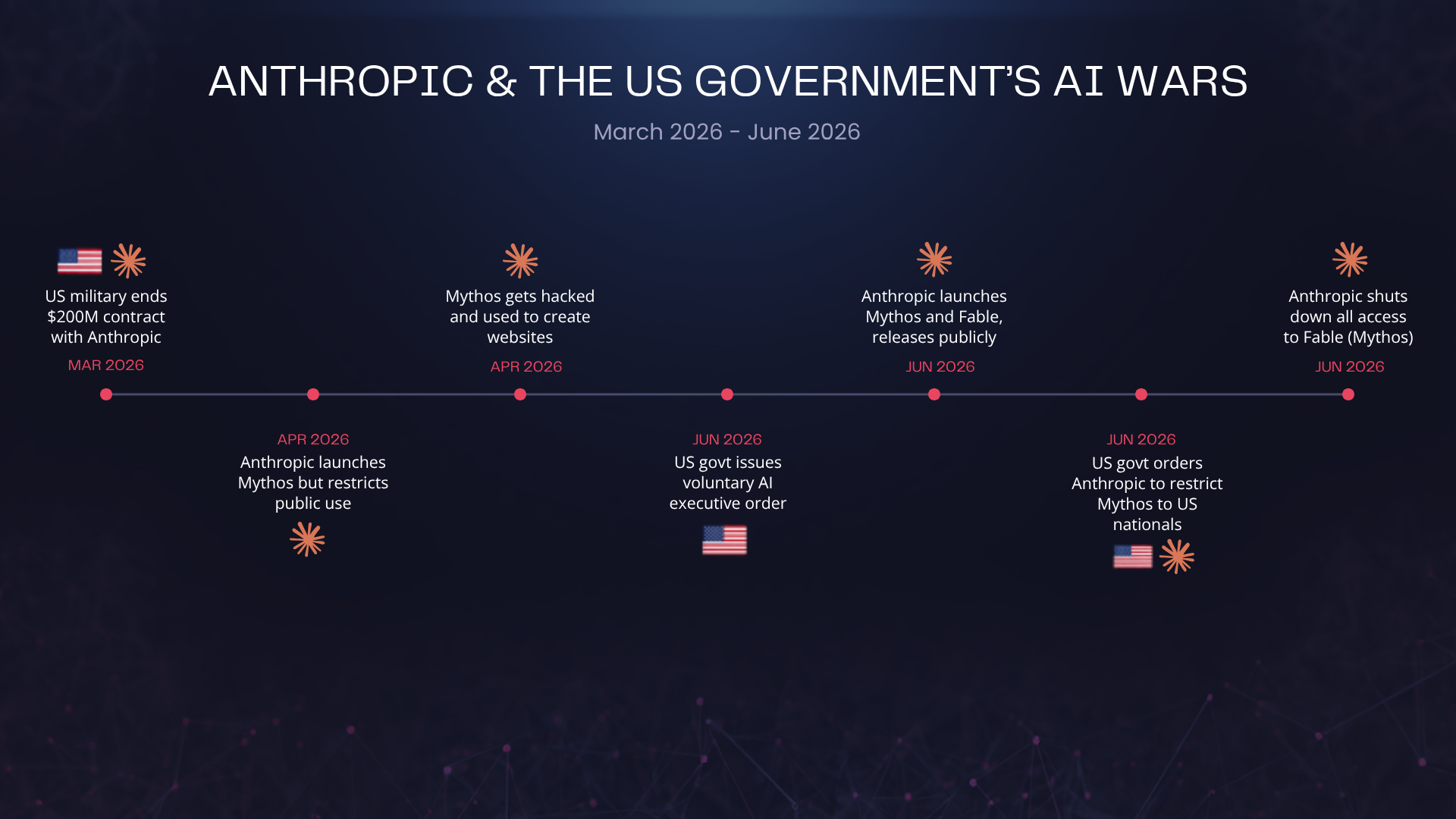
Anthropic and the US’s government’s 2026 timeline
I understand why the US’ government is reluctant to put any regulation on AI. They’ve always taken the stance of letting the AI labs run the show. But with technologies that are reportedly self-improving (whether it’s true or not), leaving AI to run amok unregulated is one sure step to disaster.
And if I were a leader in Anthropic, I'd change the marketing and PR strategy from crying wolf at any new release, to keeping mute and only highlighting ground-breaking “positive” capabilities. Basically, learn from the likes of Google, Microsoft and even OpenAI on this front.
So the hokey pokey song continues, the world has been shaken around with all of this mallarkey and any highly enthusiastic and loyal users of Fable 5 have been left disappointed. And if any major workflows or work was dependent on this model, people have been left to fend for themselves. Which brings me to my next point - company dependence on generative AI.
If your entire organisation, products, workflows, and services are heavily dependent on AI, particularly generative AI, you’re setting yourself up for a massive failure. You see, GenAI wasn’t built for enterprise. It was adapted to suit enterprise. And that’s why the top AI providers are called “AI Labs”. It’s quite obvious it’s still highly experimental, changes almost everyday and can be very unpredictable. So why would anyone want to build a business model on 1) A technology that you don’t own and can’t control, and 2) One that is not yet fully regulated and can be turned off and on at any time.
Rather than building your entire business model on GenAI, reduce this to a smaller percentage, focusing on the parts of the business that heavily need automation. Run this as a pilot for the first 6 months or so, measure success and ROI before launching full-scale. And no, it’s not too late to reassess your current AI adoption roll-out. It’s never too late.
Another advice I always give is not to be the first to adopt a new model. You can try it out, play with it, but don’t move your entire workflows or production database to a newly released GenAI model. See what’s happened with Fable.
It’s going to take the industry a good number of years before it stabilises, has the right meaningful regulations, is actually productive, drives ROI, and is a safe technology for all users and communities. This is heavily dependent on law makers and policy makers. And it looks like the Trump administration is not quite sure where they sit, giving China and Xi Jinping the time of their lives.

Xi Jinping having a laugh
In other news outside the melodramatic, never-ending, keeping-everyone-on-their-toes, fabulous country of the United States, the UK is taking AI sovereignty and regulation more seriously.
The UK just announced a Social Media ban for under 16s. Huge and highly applaudable move, although there are still lots of areas to unpack and address. This also means less dependence on US Tech, and less revenue and dominance for the US’ social media companies.
The UK is also slowly breaking up with the US, and is working towards its first frontier AI model (about time huhn) called Lumen Sovereign. Lumen will be trained on Isambard-AI, built by the University of Bristol and is considered one of Europe’s most powerful supercomputing systems.
My 2 cents about AI sovereignty is to ensure that the AI models developed by the country are indeed built to address the country’s needs, safely and accurately. If it doesn’t do this and only works in the country’s languages and cultures, it defeats the purpose.
Moving on to the EU, Google received a ruling from the Court of Munich that the company is liable for a series of false statements generated by its AI Overviews feature and that Google has to prevent the dissemination of erroneous and inaccurate claims through its search engine.
In the typical predictable and unpredictable manner of LLMs, Google AI overviews falsely accused two publisher organisations of questionable business practices, scams, and subscription-related frauds, unprovoked. You know this is what we call AI hallucinations. And the impact of these awful inaccurate results can be extremely damaging to businesses.
Let’s be honest, Google can’t fix this problem. AI hallucinations cannot be fixed with the current infrastructure of GenAI models. So Google would either have to stop AI overviews from appearing in Germany, or de-prioritise the AI overview features on the SERP (Search Engine Recommendations Page). So rather than having the overviews as the first dominant result, it’d be somewhere in the middle of the page. Quite similar to what Google had to do when they faced a Travel fine in the EU. But this won’t solve the problem if the LLM would still spit out false information.
This ruling also shows a new front on AI accountability which has been a game of ping pong in the AI ethics and AI field for many years, where AI providers shirk from the responsibility of being held liable and accountable for the results of their AI products. Guess the law is now catching up and won’t let AI providers run away from these responsibilities anymore.
It’ll definitely be fun and games in the world at large with AI for the next foreseeable future. Of course, not fun and games for a lot of people negatively impacted by the decisions or lack of it thereof from the results of GenAI models.
So on this note, I’m off to watch the world cup while betting Spain will win today’s match while reminding myself it’d be an absolute miracle if England brings the cup home! Maybe we could just get a LLM to hallucinate on this one.
And for those of you, itching to finish singing Hokey Pokey, here you go - you can thank me later.