
Say Goodbye to AGI
I know I’m going to ruffle a few feathers on this one. Mind you, that’s what I do for a living - I’m a feather ruffler. So hang on tight all you AGI hopefuls, ride with me on a journey analysing AI’s biggest bet and what the current state of affairs mean for the sci-fi sweetheart - Artificial General Intelligence, also known as AGI.
We are at a significant inflection point in human history. One that will change the course and trajectory of human existence for a very long time, if not forever. I know these are very bold statements, but trust me, being one of the few people who recognised the potential of AI way back in 2019 and recognised the gravity of its harms - long before Gen AI became a thing. And everything I have seen, predicted and have been cautious about, has occurred over and over again over the past few years.
So much has happened in the last couple of weeks and they have been way more significant than the continuous model releases or geopolitical play between the US, China and the Rest of the World.
In the world of AI and humans, we are beginning to see a resistance. A resistance and revolution where the blindfolds and automation biases of AI are slowly fading away. From the Pope’s recent AI encyclical calling on a moral duty to humanity and accountability for AI, to the new and growing AI resist list, to Amnesty’s international’s call to stop Generative AI completely, and the end of the AI token-maxxing, where employees were made to use up as many AI tokens are possible - AI is no longer allowed to take people’s jobs, destroy human lives, or suck up years of revenue in companies. Or rather, the AI developers will no longer be able to easily wreak havoc with a technology that so far is doing more harm than good.
And mind you, this is history repeating itself. Remember the Luddites from the 19th century who vehemently pushed back against automation during the first industrial revolution. They fought against the elimination of wages where mill owners were using machines to undercut labour practices and reduce salaries. They also protested against inhumane working conditions and unskilled labour. They laid the foundation for critical thought between society and lawmakers on the human cost of untethered and unchecked technological progress.
Now we’re seeing similar resistance across the world. Let’s deep-dive into some of these, and what this means for the future development of AI.
The Pope’s Encyclical Magnifica Humanitas on AI: Pope Leo XIV released an encyclical - which basically means an official pastoral letter - outlining the importance of safeguarding humanity in the age of AI. The pope also recently tweeted that AI is not conscious and cannot experience human emotions or experiences. Quite similar to my last newsletter on Artificial Consciousness where I outlined a few reasons why AI agents or LLMs are not sentient or conscious. Regardless of where you stand on the religious spectrum, it’s good to see public figures speaking up about the importance of protecting and safeguarding humanity.
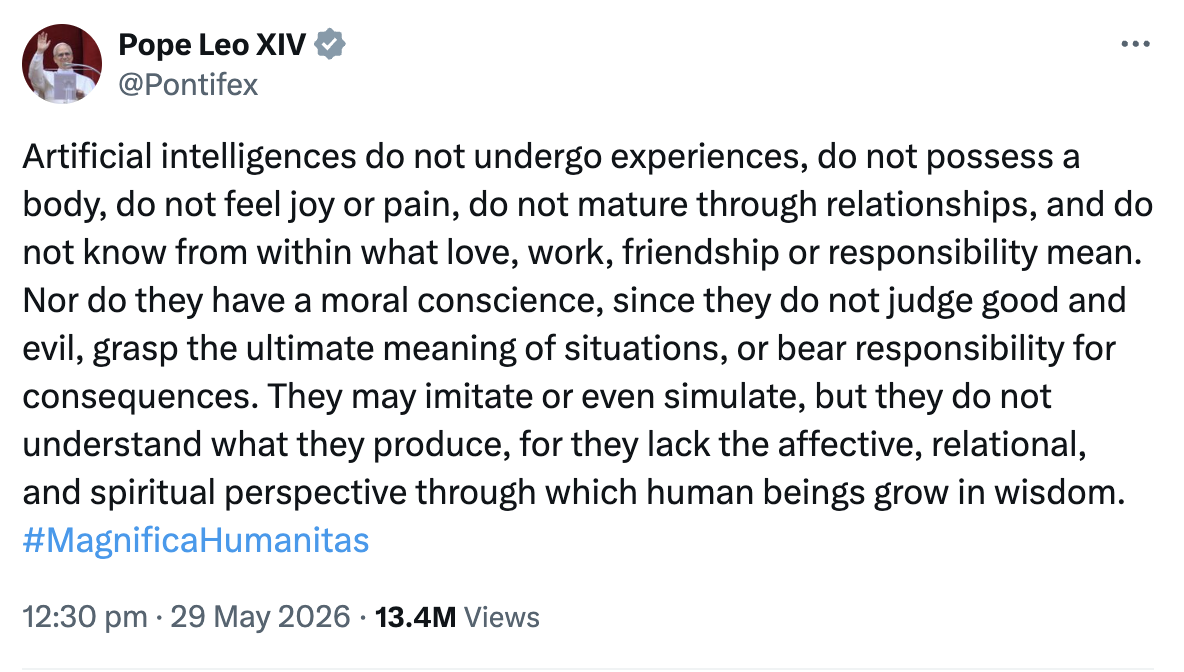
Tweet from the Pope on the AI encyclical
Dr Milagros Miceli summarised the encyclical quite nicely while highlighting the unethical practices of AI’s labour and supply chain which shouldn’t go unnoticed or unaddressed.
On my part, I wonder if the pope is able to convince Dario Amodei that Claude is not in any way conscious 🤔
Amnesty International’s call to stop the production and use of standalone Gen AI systems due to various human rights violations mainly through the design, development and deployment.
The newly formed AI Resist List: Now this one is quite interesting, because I remember a repeated question that has come up during my keynotes after I outline the benefits and risks of AI. I’ve been asked this question over and over again “Why are we still using AI? Can we stop using it?”
I’ve also seen recent movements to boycott AI due to the ongoing psychosis and harm it’s having on people, the planet and children. So to see this AI Resist List makes the resistance, revolution and pivotal moment - real. No one is sleepwalking through this seeming apocalypse anymore. Researchers are beginning to work on new research exploring a world without AI or a better alternative to present day AI.
CEOs are beginning to question their ROI after seeing years of hard earned revenue burn through AI tokens on work they’re not sure is critical. Which leads to the next point.
The end of AI tokenmaxxing: In the first edition of AI Reflections, I mentioned the never ending churn of AI change. Well here’s another proof backing that statement. Tokenmaxxing where CEOs and senior executives decide that the best way to get their employees to use AI is by making them use as many AI tokens which leads to employees either getting rewarded for their efforts or penalised. Well go figure, that move was very short-lived. It lasted for less than 5 months!
Here’s why tokenmaxxing is officially over.
Amazon shut down its internal AI leaderboard which tracked AI token use as staff performed tasks just to climb the ranks.
Uber burned through its entire 2026 AI budget in only 4 months on Claude code tokens, and the COO is now trying to understand the benefits of using Claude code versus creating innovations for their customers.
Nvidia’s VP also stated that the cost of running AI compute is far higher than the salaries of human employees using the tools.
A company reportedly spent $500 million in a month due to unrestricted Claude usage by employees.
I’m crying with the CEO right now.

At the beginning of this year, I made a comment on LinkedIn stating that AI needs to be implemented with the right strategy, use cases and measures in place otherwise it’d backfire. I’ve actually been saying this for some time now, but I also stated that a lot of senior executives would rather learn from experience, and it’ll be a bitter one at that if caution isn’t taken.
At this point, extra caution needs to be applied in AI spend and initiatives. Make sure you understand what you’re using your Gen AI model for, why it’s needed and how you’ll measure success. AI, especially AI agents should still be seen as a pilot and used as a beta for the time being.
Well as the saying goes, life goes on so the life of model releases are continuing, while we hear new statements from Sam Altman and Dario Amodei that AI is unlikely to cause the massive job losses they both warned about. I think it’s a bit too late for that now, aye?
Alright, for the model release junkies, sorry enthusiasts, here are a few launches for you:
ElevenLabs launched Dubbing v2, the first AI dubbing model that preserves the original speaker’s emotion, tone and delivery across 90+ languages.
Anthropic launched dynamic workflows in claude code where one task enables tens to hundreds of subagents running in the background.
Anthropic also launched Claude Opus 4.8, its most capable public model, and is 4x less likely to miss flaws in its own code than 4.7.
Now back to my initial argument regarding the demise of AGI, a sci-fi fantasy that hasn’t materialised. From the look of things, with the increasing resistance to AI, data centres and the heavy demands Gen AI is having on water (and energy), the drastic effects it has on human society, the questions around ROI and the upcoming IPO valuations between Open AI, Anthropic and a few others; and the continuous ongoing global regulations, the never-ending resources to finance and build AGI, and the initial support AI labs had, is diminishing.
So the question on the possibility of AGI is a bit irrelevant right now. What’s pressing is “how will AGI be built if the sentiment towards AI keeps on declining and the trillions of dollars needed to fund it aren’t achieved?”
I’m still a strong believer in the dynamic possibilities AI can bring to the human race. It’s already doing this in a few ways across healthcare, marketing, manufacturing and so on.
I believe there is an alternative to present-day AI, from its development, deployment and use; and I think it’s about time we start looking into an alternative AI that benefits humanity.
Before I sign off to finish reading the fantastic book by Khaled Hosseini - A Thousand Splendid Suns, I’ll leave you with this funny and very spot on video by the European Parliament.