
Is AI an Enabler or Disruptor?
I consider one of my superpowers to be speaking. Speaking about my work, my past experience at Google, being one of the early ones who recognised AI’s potential long before ChatGPT! Actually before Sundar Pichai even realised AI was a thing. A big thing.
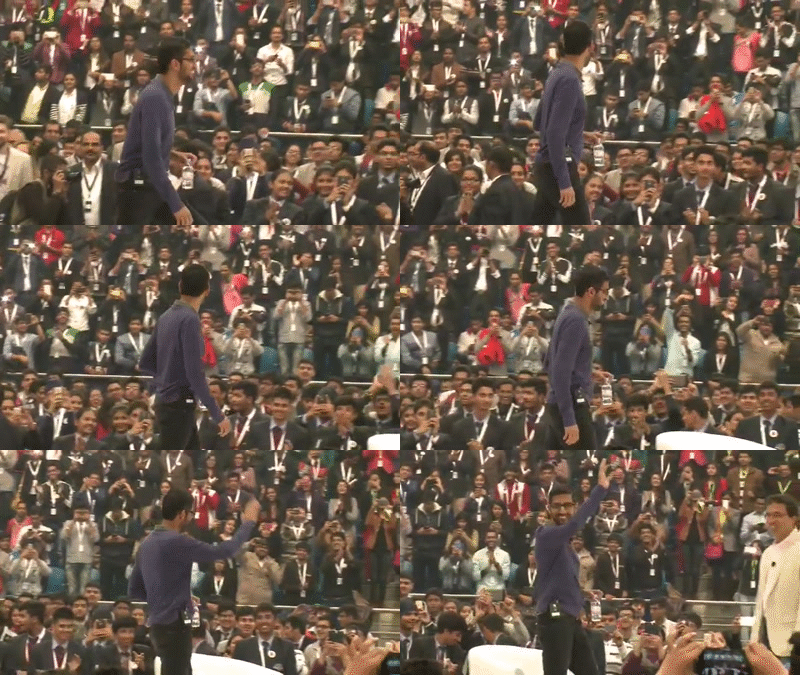
So it didn’t surprise me when a VP from Expleo asked this question after my keynote during an Expleo partner event in London a few weeks ago. The question went along these lines: “Toju, we’ve built a humanoid work assistant in our company. How do we go about ensuring it's responsible and useful for our organisation?”
Before I go into my long answer to the question, you’re probably wondering what in the world I talked about during my keynote. Well, I spent about 15 minutes talking about my neighbour’s cute cat who always snuck into my house to purr and cry at me at every opportunity he got. I’m not lying, there he is. Cute little Tux.

Tux, the cute little cat
Ok that’s a lie. My keynote didn’t cover Tux, it covered AI - of course! And responsible AI, of course. And how the world has been torn apart by AI, organisations have been blinded and blindsided and have jumped in head first, to adopt a technology that we know very little about. But I also covered what we need to do while using, building and deploying AI at work, and also at home.
The thing is AI could be great, exceptionally great, drive revenue, profit, customer satisfaction, new customer acquisition etc., and it could be bad, very bad, and reduce productivity, cause cognitive decline, drive misinformation, lead people astray through psychosis, give false information aka AI hallucinations, increase energy shortage, destroy the environment, threaten national security and so on.
But most of this sounds quite familiar. It can be compared to a few moments in history such as the gold rush. Some were quite short lived and some lasted much longer. Most led to fortune and wealth for those that were lucky and often wealthy, while it had a terrible effect on the environment, wildlife, cultures, and society.
Well, we’re living in times that are considered to be the “AI gold rush” and the “AI arms race”. 2 scenarios, 2 realities, and 2 dilemmas all at once.
Is this a good thing? Well it depends on what side of the coin you belong to. If you’re a stinkingly rich billionaire, you’ve probably already pumped millions of dollars into AI investment, and of course, you’d say the current AI gold rush is the best thing that has happened in human history.
If on the other hand, you’re a middle class worker, or belong to the poorer end of the spectrum you’re caught up in the middle, may be aware of the impact AI is having on society and the economy, or utterly confused about what’s going on. For some, the focus has been on the hype, and for others across the developed world, the focus has been on an increasing fear of the looming AI jobs apocalypse - something I’m now beginning to question (A topic for another day).
Here’s the thing. AI today is benefitting less than 1% of the world’s population. It appears to be a profit-making machine for the Mag 7 only. It seems that the most profit has gone to the AI chip developers such as Nvidia. However, this could be a temporary boom for Nvidia, given the competition with China and the latest threat from Google with their TPUs (Tensor Processing Units) which powers their entire AI ecosystem.
If you’re caught up in the middle - you don’t identify as a top tech billionaire so the prospects of benefitting from the current gold rush and boom are quite slim, next to nil and you’re well aware that your taxes might be used to bail out the tech companies if the bubble does go bust. Or you’re just a normal everyday worker, not making any trouble and minding your own business. Depending on the part of the world you find yourself in, you’d have most likely spent some quality time with one or many AI tools by now.
Most companies (sector dependent) have made immense progress in AI adoption and deployment, but are yet to see impressive results particularly on revenue.
The truth is, AI is still very much an emerging technology. It hasn’t been proven yet, to be that business-enabling, productivity-increasing, most-intelligent entity that ever existed. And for companies already using AI, it could be worse if heavy investments have been made without implementing a robust AI strategy that includes policy, governance, standards, and safety measures.
It’s a bit too late to pull the plug, and we don’t have a strong need to at the moment. But for anyone using AI either on a personal or professional level, you must understand that you can’t take it at face value. As an example, AI agents are still not working properly. A recent study from the University of Berkeley, Stanford and a few other organisations, shows that only 5% of agents work as they should, and they still require human oversight. We’re not anywhere near 100% AI automation.
We also have more findings revealing the human labour behind seeming AI products. Amazon was accused of claiming AI automation in its supermarkets while they actually relied on thousands of data workers to fake this automation. There’s also the CEO of a shopping startup who was charged with fraud for claiming their system was powered by AI when they were using human labour from the Philippines and Romania. We also have the CEO of Fireflies, a $1B AI company admitting to transcribing video calls while claiming they were AI generated.
These stories are mind-blowing but proves to show that “all that glitters isn’t gold”, and AI still has several years to be the technology we believe it is today. And I’m not even talking about AGI.
AI will only work as it should, with close monitoring, planning and insight. And it has a very negative effect on humans that are heavy users. From AI psychosis, to AI work slop, it’s becoming more apparent that AI tools are not the magic wand we were sold and to get the most out of them, we need to understand the intricacies of the technology, have the right policies, protect our customers, consumers and users including the workforce, and ensure literacy across all users while reducing the time spent with AI tools, which has led to several detrimental outcomes.
There’s still so much to unpack. There’s still so much to learn. But with the little we’ve learned so far, AI isn’t all that, and to gain the benefits of AI, you really need to have the knowledge and understanding on how to navigate it.
I’ll end on this note - Is AI an enabler or disruptor? You decide.


Here are some additional pictures from the lovely event mentioned at the start of this blogpost.