
AI vs Gen AI: Future-proofing your business
Ah, I can now say I enjoyed all my ice-cream during the treacherous heat wave and was able to dream about chilling on the beach on my next holiday. You know why, right? We’ve had a quiet two weeks with no more drama between Anthropic and the US Government, hurray!
I mean it even sounds like they’ve kissed and made up as the US government recently approved a limited release of Mythos 5 after the initial lockdown, sorry ban of its use a couple of weeks ago. If you missed all the deets, you can read it in my last newsletter. Just promise you won't do the hokey pokey once done!
Until the next fight between the 2 (crossing-fingers we’ll have some peace for a while 🤞🏽), so far the Commerce Secretary of the United States informed Anthropic it could deploy Mythos 5 to a select group of customers and partners, stating that the government was confident in the guardrails Anthropic had put in place. Mythos will be restored to about 100 organisations including government agencies and private companies.
There have been a few other events that happened about the same time however, which has raised a few eyebrows, mine included.
Zhipu AI (Z.ai), a Chinese company recently released GLM-5.2, an open-weight frontier AI model that can be easily downloaded and run on your local drive / hardware. It’s very good at agentic AI tasks such as planning, coding, testing and looping - basically the sort of automation most companies are interested in.
GLM-5.2 is also catching up with the US’ frontier models and is within one percentage point of Anthropic’s Opus 4.8 on a key agentic benchmark, at roughly one-fifth of the cost.
The major highlight of GLM-5.2 is its ability to detect software security flaws and bugs, quite similar to Mythos. As it’s easily downloadable and users are able to modify it without supervision, it gives hackers an opportunity to work on a tool without any oversight or supervision.
So in other words, Mythos is no longer the most powerful AI model that must be stopped to prevent world-altering and life-changing cybersecurity attacks. We now have Z.AI’s GLM-5.2 as a worthy competitor.
But wait a minute, why isn’t the Chinese government freaking out and locking down GLM-5.2? Don’t they see the same threats? Or maybe they don’t even perceive the acclaimed threats as anything to be worried about.
Anyways, immediately after GLM-5.2, or around the same time of its release, the US government coincidentally allows Anthropic to release Mythos, and also curtails Open AI’s release of GPT5.6, to a select number of partners.
I didn’t smell a rat at all, did you?

Let’s face it, the geopolitical AI wars will never end as long as AI remains a leading technology, system and political tool interwoven with capitalism, technocracy, inequities and control.
Now that the automation bias is slowly wearing off and CEOs are beginning to question their ROI, word has it that large companies are considering moving their tech stacks over to the Chinese AI models.
And if the rest of the world moves over to using Chinese AI models, China will regain its place as the world’s superpower where not only manufacturing and clothing depends on Chinese suppliers (amongst others), but AI as well. Especially if the US’ government doesn’t put its ducks in a row, stops the erratic “release, halt, and release” orders and enforces some form of regulation on AI. And the EU doesn't speed up its sovereign AI plans.
Recent conversations and questions surrounding AI investment and ROI are on the cost-effectiveness of AI, control and sovereignty. The likes of GLM-5.2 enables enterprises to download, fine-tune and run the model on their own servers which is a sweet and viable solution for any business owner wanting to get the best value for money.
Which leads to my next and final point: How do you future-proof your business in this never-changing world of AI? Especially if you’ve restructured your teams, tech stacks and processes to accommodate, procure, deploy and use AI extensively.
To avoid erratic halts to your business from orders out of your control due to a heavy reliance on US’ tech / AI models, you’ll want to start thinking about how you can gain some more control over your AI processes. Would moving over to a Chinese AI model be more cost-effective? And if so, what are the implications on national security and the privacy of your data? How about reducing your reliance on cloud providers, and working with local or edge AI solutions as an alternative?
In addition to the above-mentioned considerations, here are a few tips to ensure you’re not setting yourself or your company up for failure during AI adoption and use:
Hybrid AI workflows - Your AI workflows should remain hybrid, a mix of AI and human oversight. Don’t replace all your software engineers or staff with AI. It’s backfired for companies that have done so in the past, and it’s still backfiring. Here’s a recent one from Ford:
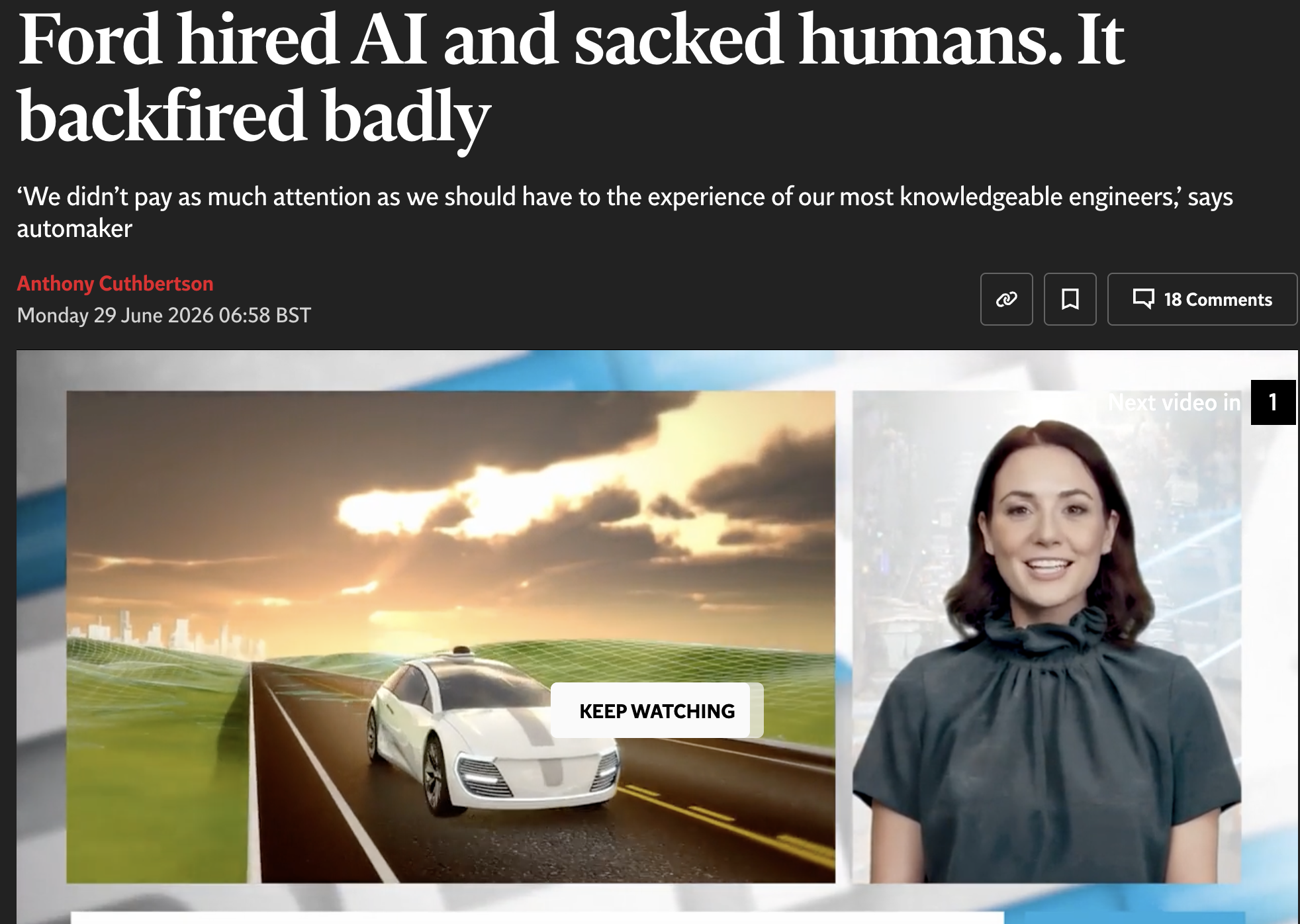
IYKYK
2. Talent management - You know what makes a company? It’s not AI and never will. It’s the people! Successful AI transformation processes should have a 70% focus on people and processes, and 30% on automation, algorithms and technology. Because at the end of the day, your company will ground to a halt if your employees are AI agents or bots. And you know why? Because your customers aren’t.
3. Secure your data and risk management processes - Ensuring you have risk management processes, AI governance and responsible AI processes enables you to stay useful, relevant and sustainable in the current age of AI automation. Don’t mess about with your data and governance policies. Implement robust data and governance policies across your organisation. This will enable trust amongst your customers and prevent potential issues / fines with current and upcoming regulations. I’ve covered this topic extensively in my two books: “Building Responsible AI Algorithms” and “Responsible AI in Practice”.
It’s also important to stress that traditional AI and generative AI are two different types of AI. Both should be used hand-in-hand, where the former is more cost-effective and accurate than the latter. So if you’re already using generative AI across all the functions of your business, review where it’s actually needed, what the results are and how much tokens / credits / money have been spent. Replace redundant parts of the business that do not require Gen AI or Agentic AI with traditional AI methods, like predictive analytics or predictive AI, conversational AI, Prescriptive AI and so on.
I’ll end off on this note. Automation bias is something that has plagued the human race for many decades and the latest wave of AI technologies has brought that to the fore. However we still possess human judgement, intelligence, critical thinking and so many other important cognitive skills which we must utilise when adopting AI transformation processes across our organisations.